


Hallway Interior Design Ideas 2026
Hallway Colour Ideas 2026
01. Go Bolder Than You Think
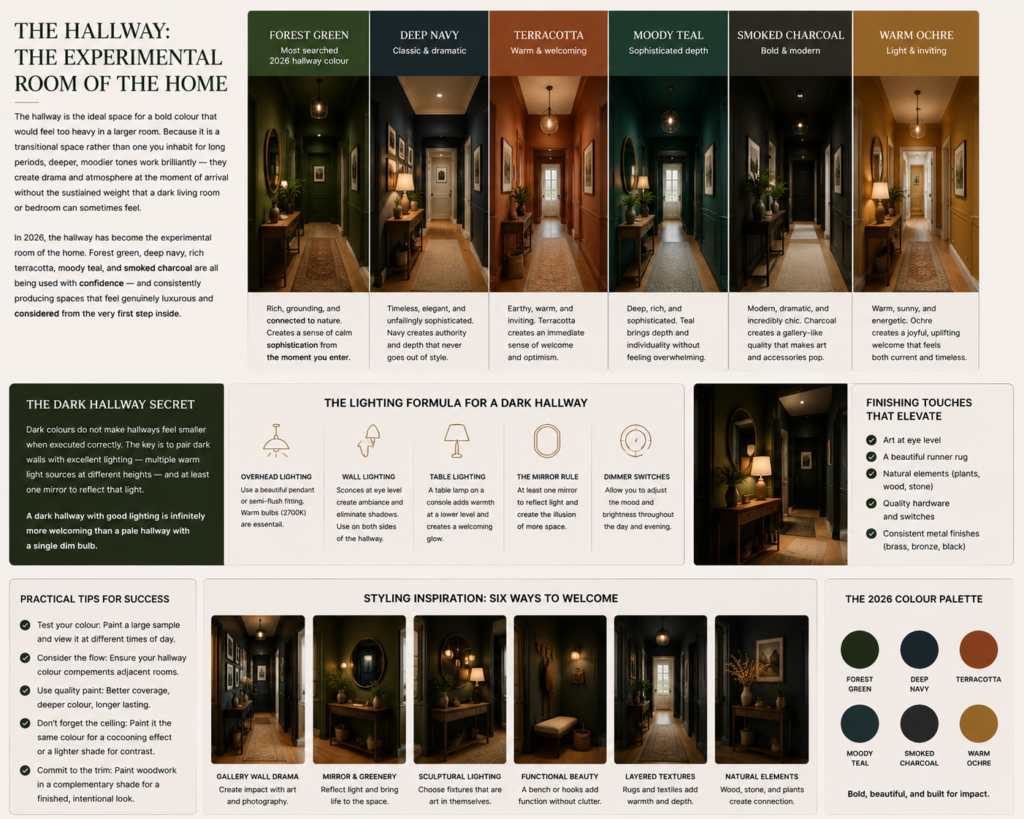
The hallway is the ideal space for a bold colour that would feel too heavy in a larger room. Because it is a transitional space rather than one you inhabit for long periods, deeper, moodier tones work brilliantly — they create drama and atmosphere at the moment of arrival without the sustained weight that a dark living room or bedroom can sometimes feel.
In 2026, the hallway has become the experimental room of the home. Forest green, deep navy, rich terracotta, moody teal, and smoked charcoal are all being used with confidence — and consistently producing spaces that feel genuinely luxurious and considered from the very first step inside.
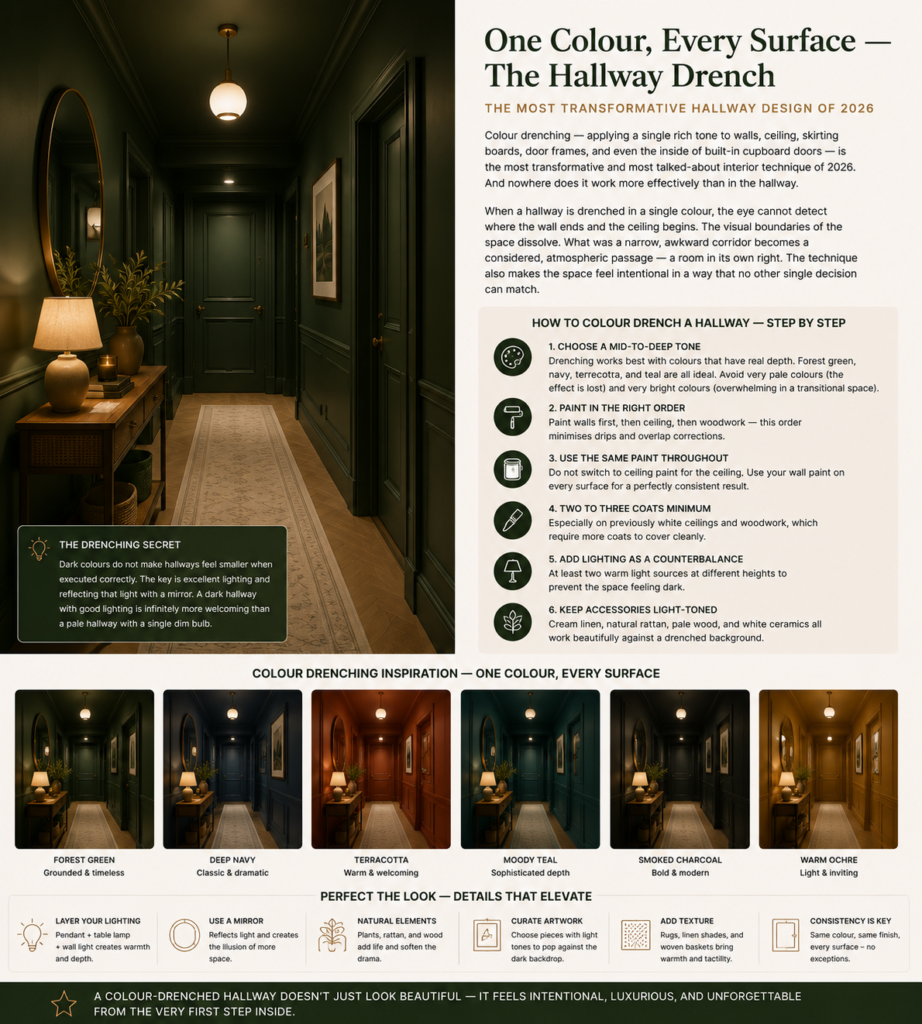
Forest GreenMost searched 2026 hallway colour
Deep NavyClassic & dramatic
TerracottaWarm & welcoming
Moody TealSophisticated depth
Smoked CharcoalBold & modern
Warm OchreLight & inviting
The dark hallway secret: Dark colours do not make hallways feel smaller when executed correctly. The key is to pair dark walls with excellent lighting — multiple warm light sources at different heights — and at least one mirror to reflect that light. A dark hallway with good lighting is infinitely more welcoming than a pale hallway with a single dim bulb.
Colour Drenching in the Hallway
02. One Colour, Every Surface — The Hallway Drench
Colour drenching — applying a single rich tone to walls, ceiling, skirting boards, door frames, and even the inside of built-in cupboard doors — is the most transformative and most talked-about interior technique of 2026. And nowhere does it work more effectively than in the hallway.
When a hallway is drenched in a single colour, the eye cannot detect where the wall ends and the ceiling begins. The visual boundaries of the space dissolve. What was a narrow, awkward corridor becomes a considered, atmospheric passage — a room in its own right. The technique also makes the space feel intentional in a way that no other single decision can match.
How to Colour Drench a Hallway — Step by Step
- Choose a mid-to-deep tone — drenching works best with colours that have real depth. Forest green, navy, terracotta, and teal are all ideal. Avoid very pale colours (the effect is lost) and very bright colours (overwhelming in a transitional space)
- Paint walls first, then ceiling, then woodwork — this order minimises drips and overlap corrections
- Use the same paint throughout — do not switch to ceiling paint for the ceiling. Use your wall paint on every surface for a perfectly consistent result
- Two to three coats minimum — especially on previously white ceilings and woodwork, which require more coats to cover cleanly
- Add lighting as a counterbalance — at least two warm light sources at different heights to prevent the space feeling dark
- Keep accessories light-toned — cream linen, natural rattan, pale wood, and white ceramics all work beautifully against a drenched background
Wall Panelling & Feature Walls
03. Wall Panelling — Architecture Without the Cost
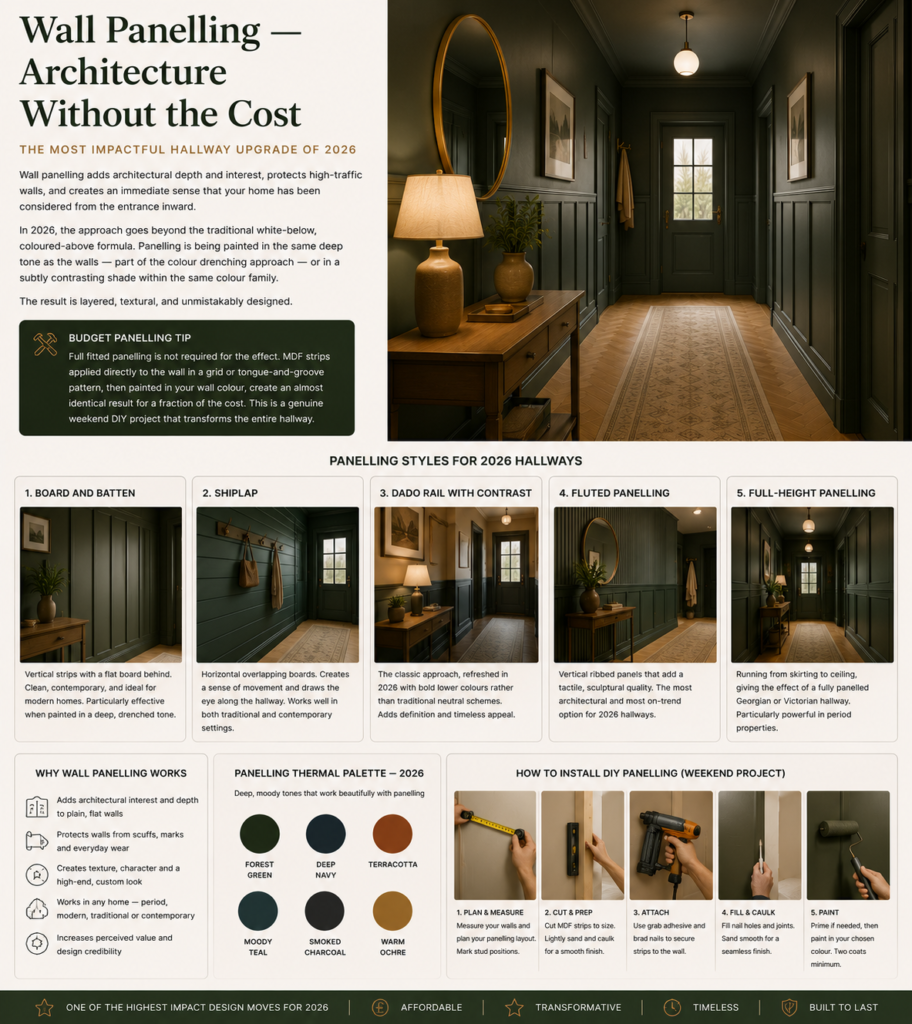
Wall panelling — dado rails, board-and-batten, shiplap, or fluted panelling applied to hallway walls — is one of the most popular and most impactful hallway design moves of 2026. It adds architectural depth and interest to what is typically a plain, flat surface, protects high-traffic walls from scuffs and marks, and creates an immediate sense that the home has been considered from the entrance inward.
The 2026 approach to panelling moves beyond the traditional white-below, coloured-above formula. Instead, panelling is being painted in the same deep tone as the walls above it — part of the colour drenching approach — or in a subtly contrasting shade within the same colour family. The result is layered, textural, and unmistakably designed.
Budget panelling tip: Full fitted panelling is not required for the effect. MDF strips applied directly to the wall in a grid or tongue-and-groove pattern, then painted in your wall colour, create an almost identical result for a fraction of the cost. This is a genuine weekend DIY project that transforms the entire hallway.
Panelling Styles for 2026 Hallways
- Board and batten — vertical strips with a flat board behind. Clean, contemporary, and ideal for modern homes. Particularly effective when painted in a deep, drenched tone
- Shiplap — horizontal overlapping boards. Creates a sense of movement and draws the eye along the hallway. Works well in both traditional and contemporary settings
- Dado rail with paint contrast — the classic approach, refreshed in 2026 with bold lower colours rather than traditional neutral schemes
- Fluted panelling — vertical ribbed panels that add a tactile, sculptural quality. The most architectural and most on-trend option for 2026 hallways
- Full-height panelling — running from skirting to ceiling, giving the effect of a fully panelled Georgian or Victorian hallway. Particularly powerful in period properties
Statement Mirrors — The Hallway Essential
04. One Large Mirror, Positioned Perfectly
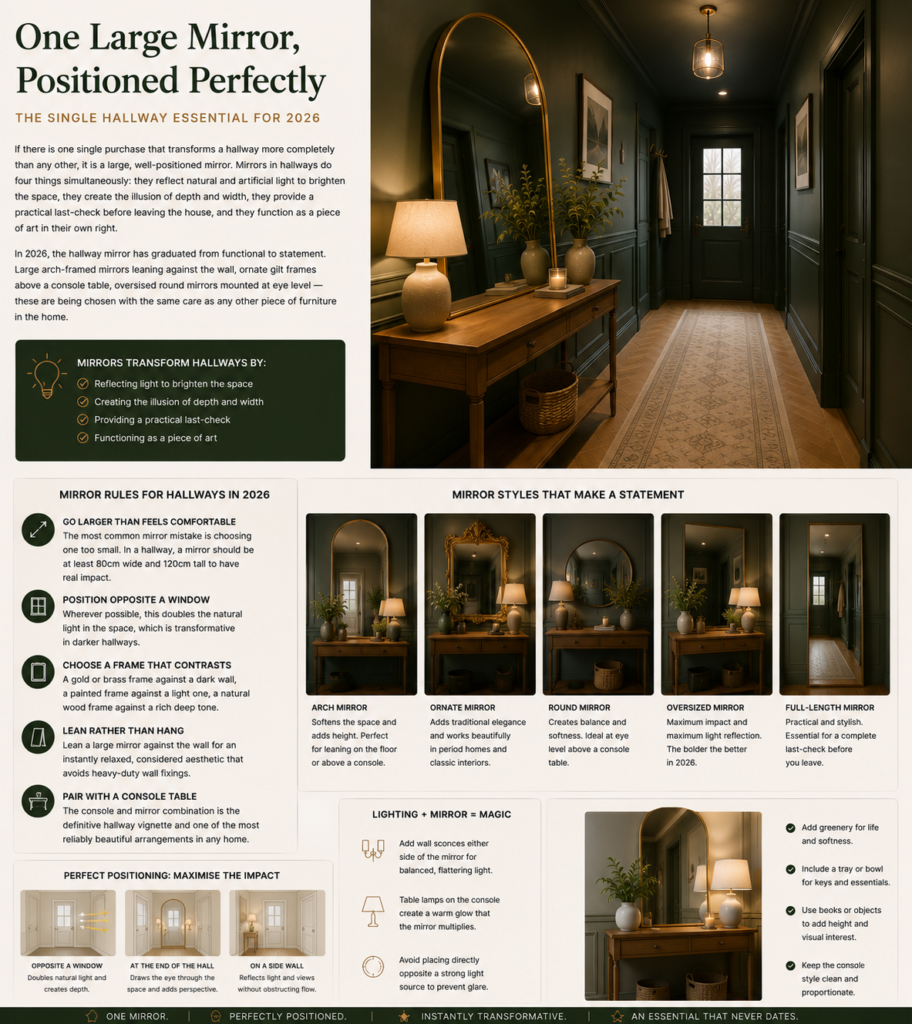
If there is one single purchase that transforms a hallway more completely than any other, it is a large, well-positioned mirror. Mirrors in hallways do four things simultaneously: they reflect natural and artificial light to brighten the space, they create the illusion of depth and width, they provide a practical last-check before leaving the house, and they function as a piece of art in their own right.
In 2026, the hallway mirror has graduated from functional to statement. Large arch-framed mirrors leaning against the wall, ornate gilt frames above a console table, oversized round mirrors mounted at eye level — these are being chosen with the same care as any other piece of furniture in the home.
Mirror Rules for Hallways in 2026
- Go larger than feels comfortable — the most common mirror mistake is choosing one too small. In a hallway, a mirror should be at least 80cm wide and 120cm tall to have real impact
- Position opposite a window wherever possible — this doubles the natural light in the space, which is transformative in darker hallways
- Choose a frame that contrasts with the wall colour — a gold or brass frame against a dark wall, a painted frame against a light one, a natural wood frame against a rich deep tone
- Lean rather than hang a large mirror against the wall for an instantly relaxed, considered aesthetic that also avoids the need for heavy-duty wall fixings
- Pair with a console table below — the console and mirror combination is the definitive hallway vignette and one of the most reliably beautiful arrangements in any home
Hallway Lighting — Setting the Tone from the First Step
05. Layer Your Hallway Lighting
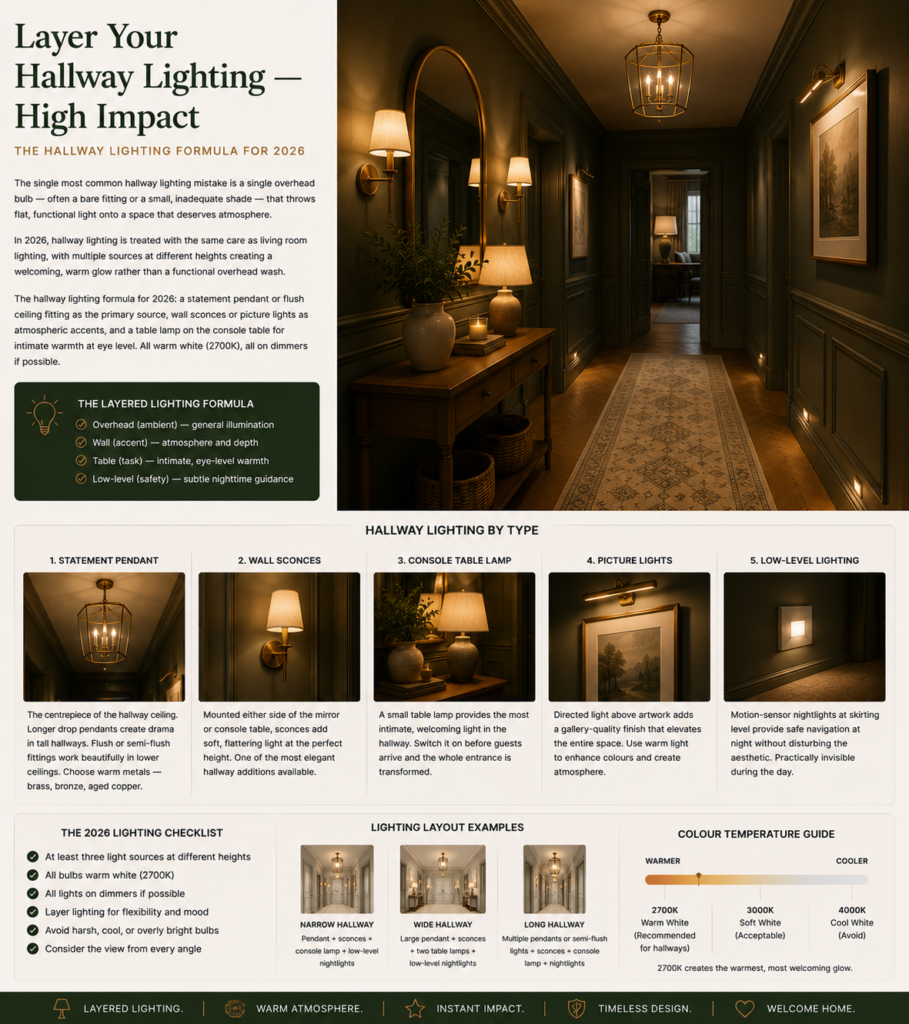
The single most common hallway lighting mistake is a single overhead bulb — often a bare fitting or a small, inadequate shade — that throws flat, functional light onto a space that deserves atmosphere. In 2026, hallway lighting is treated with the same care as living room lighting, with multiple sources at different heights creating a welcoming, warm glow rather than a functional overhead wash.
The hallway lighting formula for 2026: a statement pendant or flush ceiling fitting as the primary source, wall sconces or picture lights as atmospheric accents, and a table lamp on the console table for intimate warmth at eye level. All warm white (2700K), all on dimmers if possible.
Hallway Lighting by Type
- Statement pendant — the centrepiece of the hallway ceiling. In taller hallways, a longer drop pendant creates drama. In lower ceilings, a flush or semi-flush fitting with a beautiful shade. Choose warm metals — brass, bronze, aged copper — over chrome
- Wall sconces — mounted either side of the mirror or console table, they add soft, flattering light at a height that works beautifully in the evening. One of the most elegant hallway additions available
- Console table lamp — placed on the console table, a small table lamp provides the most intimate, welcoming light in the hallway. Switch it on before guests arrive and the whole entrance is transformed
- Picture lights — if you have artwork in the hallway, a directed picture light above each piece adds a gallery-quality finish that elevates the entire space
- Motion-sensor nightlights at skirting level — practically invisible during the day, they provide safe navigation at night without disturbing the aesthetic
Smart Hallway Storage Solutions
06. Storage That Looks as Good as It Functions
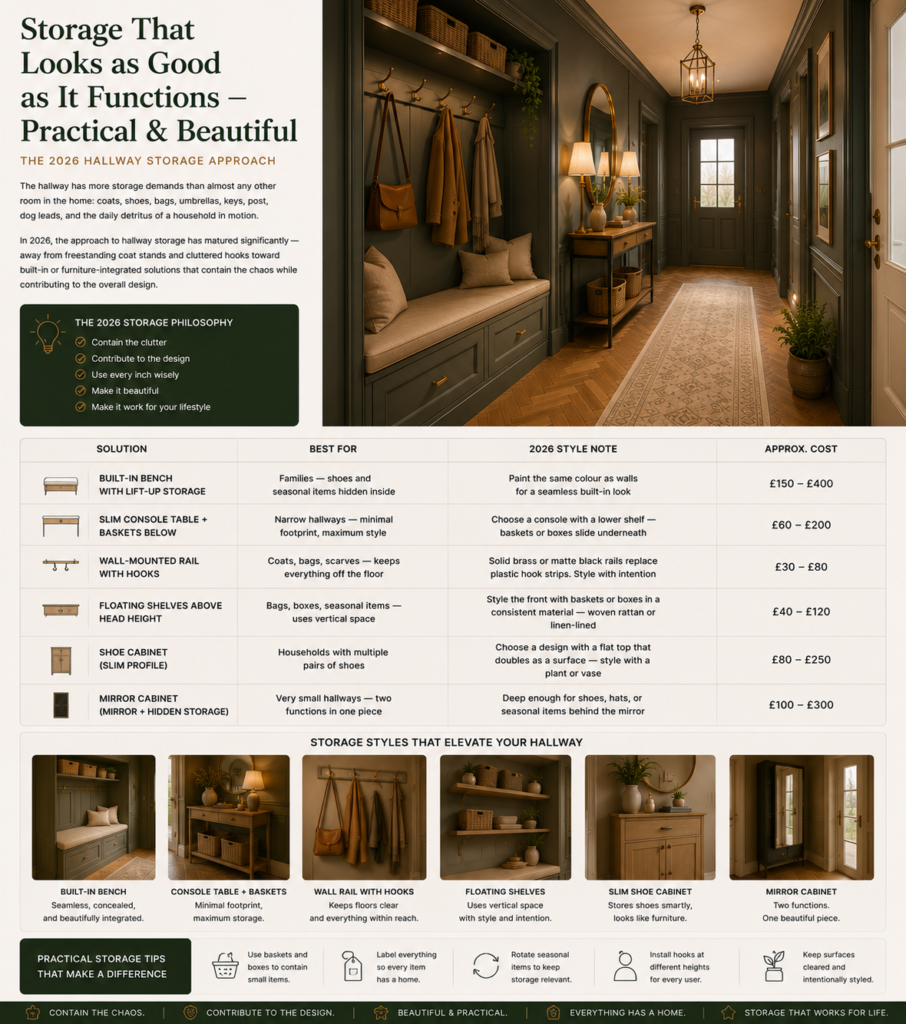
The hallway has more storage demands than almost any other room in the home: coats, shoes, bags, umbrellas, keys, post, dog leads, and the daily detritus of a household in motion. In 2026, the approach to hallway storage has matured significantly — away from freestanding coat stands and cluttered hooks toward built-in or furniture-integrated solutions that contain the chaos while contributing to the overall design.
| Solution | Best For | 2026 Style Note | Approx. Cost |
|---|---|---|---|
| Built-in bench with lift-up storage | Families — shoes and seasonal items hidden inside | Paint the same colour as walls for a seamless built-in look | £150–£400 |
| Slim console table + baskets below | Narrow hallways — minimal footprint, maximum style | Choose a console with a lower shelf — baskets or boxes slide underneath | £60–£200 |
| Wall-mounted rail with hooks | Coats, bags, scarves — keeps everything off the floor | Solid brass or matte black rails replace plastic hook strips. Style with intention | £30–£80 |
| Floating shelves above head height | Bags, boxes, seasonal items — uses vertical space | Style the front with baskets or boxes in a consistent material — woven rattan or linen-lined | £40–£120 |
| Shoe cabinet (slim profile) | Households with multiple pairs of shoes | Choose a design with a flat top that doubles as a surface — style with a plant or vase | £80–£250 |
| Mirror cabinet (mirror + hidden storage) | Very small hallways — two functions in one piece | Deep enough for shoes, hats, or seasonal items behind the mirror | £100–£300 |
Console Table Styling — The Hallway Vignette
07. Style Your Console Table Like a Designer
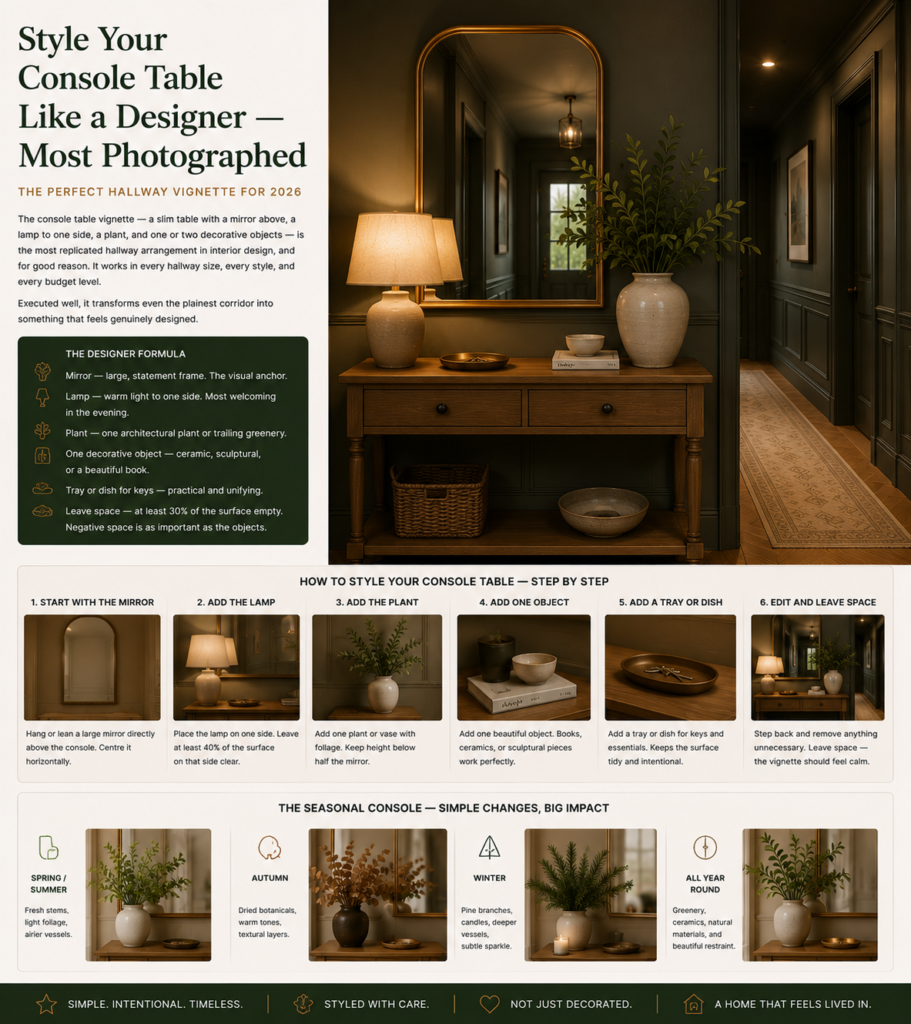
The console table vignette — a slim table with a mirror above, a lamp to one side, a plant, and one or two decorative objects — is the most replicated hallway arrangement in interior design, and for good reason. It works in every hallway size, every style, and every budget level. Executed well, it transforms even the plainest corridor into something that feels genuinely designed.
The Perfect Console Table Vignette for 2026
- The mirror — large, statement frame, hung or leaned directly above the console. The visual anchor of the whole arrangement
- The lamp — a table lamp to one side. Small, warm-toned bulb (2700K). This is the most welcoming light in any hallway when switched on in the evening
- The plant — one architectural plant on or beside the console. A trailing pothos, a small olive tree, or a statement stem in a beautiful vase
- One decorative object — a ceramic vase, a sculptural object, a beautiful book laid flat. One thing only — restraint is the mark of a well-styled console
- A tray or dish for keys — practical, always present, and visually unifying for the small objects that otherwise create clutter
- Leave space — at least 30% of the console surface should remain empty. The negative space is as important as the objects
Hallway Flooring & Runners
08. The Right Floor Sets Everything
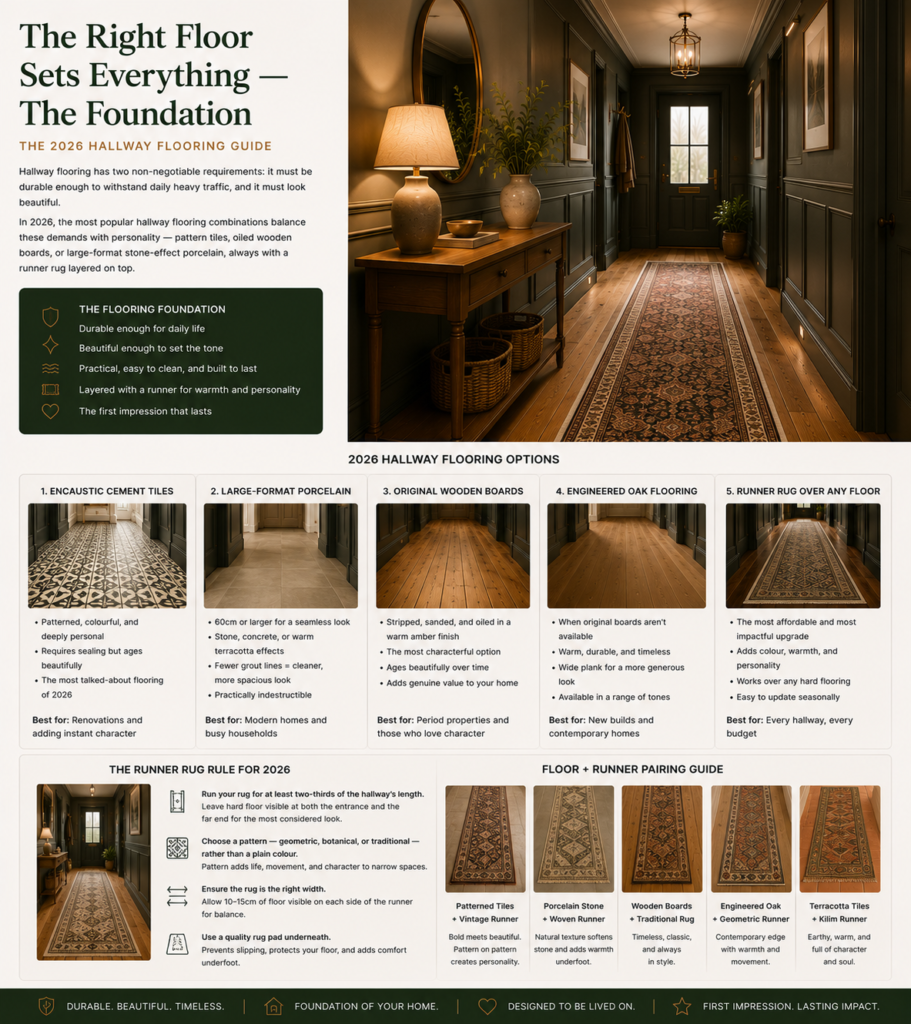
Hallway flooring has two non-negotiable requirements: it must be durable enough to withstand daily heavy traffic, and it must look beautiful. In 2026, the most popular hallway flooring combinations balance these demands with personality — pattern tiles, oiled wooden boards, or large-format stone-effect porcelain, always with a runner rug layered on top.
2026 Hallway Flooring Guide
- Encaustic cement tiles — patterned, colourful, and deeply personal. The most talked-about hallway flooring of 2026 for anyone undertaking a renovation. Requires sealing but ages beautifully
- Large-format porcelain (60cm or larger) — in stone, concrete, or warm terracotta effects. Fewer grout lines mean a cleaner, more spacious look. Practically indestructible
- Original wooden floorboards — stripped, sanded, and oiled in a warm amber finish. The most characterful option and an asset that adds genuine value to the home
- Engineered oak — for hallways where original boards are not available. Warm, durable, and available in a wide range of tones. Choose a wider plank for a more generous look
- Runner rug over any hard floor — the single most affordable and most impactful hallway flooring upgrade. A patterned runner adds colour, warmth, and personality without touching the existing floor
Narrow Hallway Ideas 2026
09. Making a Narrow Hallway Feel Wider & More Beautiful
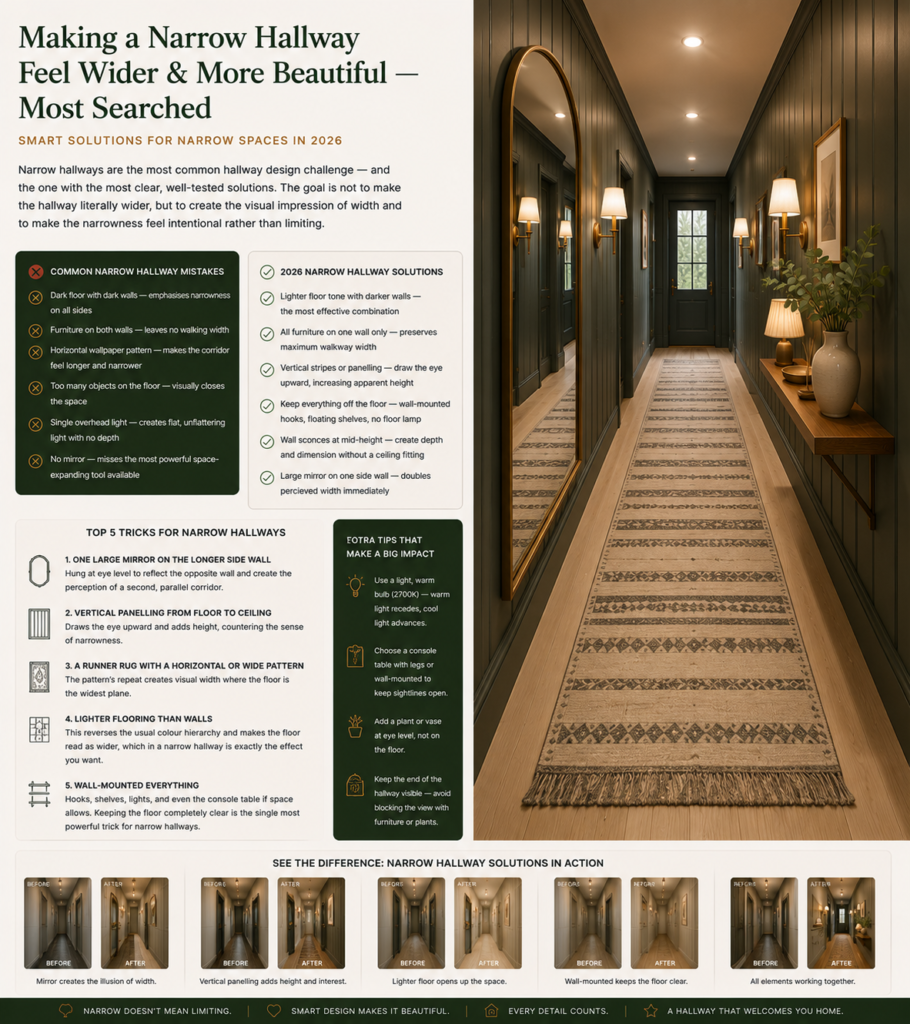
Narrow hallways are the most common hallway design challenge — and the one with the most clear, well-tested solutions. The goal is not to make the hallway literally wider (which would require structural work) but to create the visual impression of width and to make the narrowness feel intentional rather than limiting.
Common Narrow Hallway Mistakes
- Dark floor with dark walls — emphasises narrowness on all sides
- Furniture on both walls — leaves no walking width
- Horizontal wallpaper pattern — makes the corridor feel longer and narrower
- Too many objects on the floor — visually closes the space
- Single overhead light — creates flat, unflattering light with no depth
- No mirror — misses the most powerful space-expanding tool available
2026 Narrow Hallway Solutions
- Lighter floor tone with darker walls — the most effective combination
- All furniture on one wall only — preserves maximum walkway width
- Vertical stripes or panelling — draw the eye upward, increasing apparent height
- Keep everything off the floor — wall-mounted hooks, floating shelves, no floor lamp
- Wall sconces at mid-height — create depth and dimension without a ceiling fitting
- Large mirror on one side wall — doubles perceived width immediately
Top 5 Tricks for Narrow Hallways
- One large mirror on the longer side wall — hung at eye level to reflect the opposite wall and create the perception of a second, parallel corridor
- Vertical panelling from floor to ceiling — draws the eye upward and adds height, countering the sense of narrowness
- A runner rug with a horizontal or wide pattern — the pattern’s repeat creates visual width where the floor is the widest plane
- Lighter flooring than walls — this reverses the usual colour hierarchy and makes the floor read as wider, which in a narrow hallway is exactly the effect you want
- Wall-mounted everything — hooks, shelves, lights, and even the console table if space allows. Keeping the floor completely clear is the single most powerful trick for narrow hallways
Hallway Scent & Sensory Design
10. Your Hallway Sets the Scent of Your Home
The hallway is the first room your nose encounters — and scent is processed before any other sense. The fragrance that greets you (and every guest) at the door sets an immediate, powerful impression of your home before a single design choice has been consciously registered. In 2026, the hallway is increasingly understood as a sensory design opportunity, not just a visual one.
A reed diffuser in a signature scent, positioned on the console table or a floating shelf near the door, is the single most underrated hallway investment. Choose a scent that complements the season and the character of the home — woody and warm (cedar, vetiver, sandalwood) for darker, moodier hallways; fresh and botanical (lemon verbena, fig, eucalyptus) for lighter, more neutral spaces.
The signature home scent: Choose one scent for your hallway and use it consistently. Within a few weeks, it becomes associated with your home in the memory of every visitor — a deeply personal and surprisingly powerful form of interior design that costs almost nothing.